Showing posts with label art exhibit. Show all posts

Friday, August 12, 2022

Winslow Homer and his view of the stark Maine landscape

 Just a heads-up -- if you haven't been to the Maine Maritime Museum, now would be an excellent time to go!

Artist Zach Horn contacted me and mentioned his intriguing take on Winslow Homer, on exhibit now through November 27, 2022 at the museum (alongside other great exhibits!).

The show, called "Looking for Winslow Homer," is a combination of installation, painting, and stop motion animation. Zach's work is about the metaphysical connection to place.  Winslow Homer was observant and expressive enough in his work to be able to capture the unique "self" of the Maine landscape in all its guises, from pastoral to dramatic, from simple to overwhelming.  You can find info about the show here:

https://www.mainemaritimemuseum.org/exhibition/looking-for-winslow-homer/

If you'd like to check out the museum but miss the show, here's the link to their website for hours, etc.:
https://www.mainemaritimemuseum.org/

OR if you happen to be in Vermont and not in Maine, Zach is also putting together another very intriguing artshow I'm sure you'll all love, an exhibition about inexplicable occurrences which will be on display at the Bennington Museum this fall, called "In the Shadow of the Hills."

 Zach can be found online here:  https://www.zachhornart.com/

Here's one of many stunning Winslow Homer's out there in the world, many of which are held at the Portland Museum of Art:

"Watching the Breaker [A High Sea]" by Winslow Homer


Thursday, February 07, 2013

Lovecraft's influence on Maine artists

Photographer Eric Pomorski surveys his fellow artists' work.
It will come as no surprise to readers that once again I and other Portland, Maine, artists (as well as a few guests from away) have fallen under the spell of Lovecraft. The result is an epic artshow, Lovecraft: A Darker Key, which is showing at Sanctuary's gallery here in Portland from Feb 1, 2013, to May 1st, 2013 (or, Candelmas to Beltane).

The show, curated by Carrie Vinette, Michelle Souliere, and Brandon Kawashima, features the works of: Eric Anderson, Tom Brown, Clayton Cameron, Brandon Kawashima, Max Leon, Marco, Christian Matzke, Corey Paradise, Eric Pomorski, Michelle Souliere, Dave Stelmok, Jason Thompson, and Carrie Vinette.

WHAT: Lovecraft: A Darker Key artshow
WHERE: Sanctuary, 31 Forest Avenue, Portland, Maine
WHEN: Feb 1 - May 1, 2013; viewing hours 11:00-7:00 Tues-Sat
FMI: Contact Carrie at Sanctuary: (207)828-8866 http://www.sanctuarytattoo.com/

The artists involved range from illustrators to sculptors to photographers to painters, each showing his or her own interpretation of the elements of Lovecraft's stories. To quote Nicholas Schroeder of the Portland Phoenix, "Viewers, particularly those who haven't read Lovecraft, might look at 'A Darker Key'... as a richly involved visual glossary of profoundly alien terms."

Participants include such horror luminaries as Eric Anderson of the Shoggoth Assembly (who recently worked on effects for the local projects Ragged Isle and Hanover House), Mortimer Glum (currently working on art for Escape from Jesus Island), Jason Thompson (artist of the recently published Dream-Quest of Unknown Kadath), Tom Brown (artist of the recently published Hopeless, Maine), and Christian Matzke (director of Nyarlothotep and An Imperfect Solution: A Tale Of The Re-Animator).

The classic weird fiction writing of author H.P. Lovecraft forms the dark heart of this delectable array of eldritch art. Each artist was inspired by the dreamlike vistas created by Lovecraft's pen in the brief window between the years of 1917 and 1935. The world of his fiction was one of contrast between cosmic horror and eerie beauty. The title of this show references one of the stories in his Dream Cycle, "The Silver Key." Appropriately, this art show bookends the anniversary of his early death, March 15 (1937).

Come, and peer through the eyes of artists at the vision of a master writer!

Those curious about the show will find an assortment of photos from the opening night here on my Flickr page:
http://www.flickr.com/photos/darkbrilliance/sets/72157632712016012/with/8454099856/

Read more:
Blending Lovecraft and Modern Art, by Nicholas Schroeder, Portland Phoenix 02/07/13

“Lovecraft: A Darker Key” opens tonight at Sanctuary Tattoo [A discussion with Michelle Souliere], by Alex Steed, Bangor Daily News 2/1/2013

Explore the artists' websites:
-- Eric Anderson of the Shoggoth Assembly special effects group:
https://www.facebook.com/pages/The-Shoggoth-Assembly/108860862470296?ref=ts

-- Tom Brown, artist of Hopeless, Maine (Archaia, 2012)
http://www.hopelessmaine.com/

-- Max Leon, illustrator and fine artist
http://maxleonart.blogspot.com/2012/06/fine-art.html

-- Christian Matzke of Page Street Studios and Crawling Chaos
Portland Art Exhibit Imagines Counterattack on Mars, Bangor Daily News 9/2/2011
http://www.flickr.com/photos/retrogarde/sets/72157608827234238/

-- Eric Pomorski, photographer
http://www.flickr.com/photos/epomorski/

--Michelle Souliere, author and illustrator of Strange Maine: True Tales from the Pine Tree State
http://local-artists.org/users/michelle-y-souliere

-- Jason Thompson, artist of The Dream-Quest of Unknown Kadath
http://mockman.com/about/

-- Carrie Vinette of Sanctuary Tattoo
http://www.sanctuarytattoo.com/carrie.htm

Saturday, November 17, 2012

Edward Gorey in Portland, Maine!

I am pleased to take a few moments to remind folks of the opportunity afforded them by the current Edward Gorey exhibition showing at the Portland Public Library here in Maine. A longtime fan of Gorey’s artwork myself, I would hate to find out that any of you had missed out on this chance to see his work here in Maine – a definite rarity!
NOTE: Any image below can be clicked upon to see a larger version for more detail.

While Edward Gorey’s ties with Maine are tenuous at best, he is certainly a New England neighbor, lodging himself in the nearby regions of Cape Cod for the latter years of his life, and he was a great appreciator of New England Gothic sensibilities. He did a bunch of illustrations for author John Bellairs, some for stories which took place in Maine, such as the uber-creepy Johnny Dixon tale The Spell of the Sorcerer’s Skull, a personal favorite of mine, which takes place near the island of Vinalhaven. There is also a panel in Gorey’s Cycling Cards series (included in Amphigorey Also) that depicts the “Apparition of demon cyclist that appeared in the sky over Gasket, Maine several times during the second week in November, 1911.”

But here ends the Edward Gorey trail in Maine, until now.

Elegant Enigmas: The Art of Edward Gorey is presented by the Bank of Maine, in partnership with the Maine College of Art (MECA) and Portland Public Library. The show opened Friday, October 5, 2012, and will be on display through December 29, 2012 in the Lewis Gallery at Portland Public Library, 5 Monument Square, Portland, Maine. The exhibition is free of charge to the general public.

The show is phenomenal, a once in a lifetime chance to be able to see almost 200 original pieces by this master of the pen stroke, as well as some of the published results collecting those endeavors. I have done my best to take advantage of this unprecedented opportunity, a gift from the show sponsors to those of us living here, and have visited the show almost a dozen times so far. Even with that many visits under my belt, I have yet to look at everything on display!


Although the Lewis Gallery is not gigantic, it is a pretty good size, and many of Edward Gorey’s pieces are intimate in size. They are made to engage the viewer. In fact a friend who works as a security guard at the exhibit describes the inevitable process of looking at the Gorey show. People come in, scan around the room casually, strolling along the rows of framed artwork. Then one of the pieces catches their eye. They stop. They step closer. They step even closer. Slowly, they begin to bend nearer and nearer to the piece, until their nose is only inches from the glass. He tells me this sequence of events is almost inevitable.

I can imagine why. Gorey’s art is made up of infinitesimal pen strokes in the pieces where he really gets going. While this creates a pleasing and engrossing texture when the pieces are reprinted in their respective books, the printing process invariably greys out the tones of the piece. When you see one of these illustrations in person, the effect is staggeringly dramatic. In the original, the tones of ink achieve a drama unavailable in the printed version. The darks are so dark, the details so keenly applied. One cannot help but look more closely, and inspect what one might have missed previously. The colors in his watercolor paintings are also delectable in person. One imagines the glass protecting the artwork is not just to keep dust off (they know some of us just want to EAT them whole).

My own relationship as a fan of Edward Gorey’s work began with the arrival of the series of John Bellairs books mentioned above, given to me as a Christmas gift by a family friend who was also a librarian. The stories were spooky yet I was unable to stop reading them. A few years later, someone else gave my family a copy of his pop-up book, The Dwindling Party. I was fascinated by the macabre storyline of family-outing-gone-wrong and the way it was paired with the playful pop-up book format. It perplexed and amazed my pre-teen mind. But it wasn’t until I began making my own art that I really began to explore Gorey’s work.

Set design for Giselle, Act II
As an avid bookreader, it’s no surprise that my own artistic leanings took off in the direction of book illustration. Edward Gorey was a tremendous inspiration in this respect. Not only did he do typography and book cover design, he also made extensive forays into set design, costume design, and all manner of formats to which his art could be applied. His house on Cape Cod was a live-in museum filled with his collected inspirations – saltshakers, finials, rocks, and other spherical objects. Today it has become the Edward Gorey House museum. He lived his art in all ways, so that one was unsure whether his art imitated his life or his art imitated his life.

Which makes it all the more shocking that someone might say dismissively, “I’ve always thought of him as an illustrator, not as an artist,” when Gorey was so much an artist that he lived his art, with gusto, aplomb, flair, and a curious passion. This is evident in his sketchbooks, four of which are included as part of the exhibit.

Early ideas for the Gashlycrumb Tinies

His finished work is as prolific as his ideas were, totaling to over 100 published books and projects within his lifetime. This exhibit showcases everything from early concept sketches to finely finished pieces, as well as some examples of the final printed products that resulted from his projects. Viewers will also be pleased to see early versions of cover art for some of his books.

In addition to this, he designed sets and costumes for countless theatre productions, some of which are also on display, and created popular animations and illustrated works for a wide array of artists ranging from Charles Dickens and John Updike to Virginia Woolf and H.G. Wells. His hand-illustrated correspondence to his mother and his friends is also present as part of the show, a rare treat indeed.

For a supposedly reclusive person, Edward Gorey was constantly and actively involved in the world around him.

The mysteries of seaweed!
Gorey often worked in black and white, with occasional delightful forays into watercolor. Working in a single color seems a strange thing to fault someone for, though some folks seems to think it is a mark against Gorey’s work (no pun intended). This is ironic when one considers that Gorey’s epic use of delicate nib marks to create texture and definition is a skill many artists aspire to, and when one remembers that James Whistler himself considered his own monochromatic nocturnes to be extremely serious and worthy undertakings, and the fact that Albrecht Durer’s drawings and engravings are some of his most famous art pieces even now.

Illustration has always struggled against the stigma of not being “art.” It is the subject of what seems at time an eternal debate – it is, after all, one of the Big Questions: What is life? What is art? Why am I here? Where did this paintbrush in my hand come from? I think you will find the answers are purely subjective, in many cases, and gain narrow definition only at the exclusion of other potentials, which is hardly a way to live at all. To paraphrase a friend’s remark, should I feel sad if I am considered to be “only an illustrator”? Only if it turns out I'm a slipshod and artless one, I suppose.

Here’s to living one’s art, and here’s to the folks that are giving us here in Portland a chance to glimpse how the art of Edward Gorey became his.

Elegant Enigmas: The Art of Edward Gorey is on view from October 5 – December 29. The Portland Public Library is located in the heart of Downtown Portland Maine at 5 Monument Square and is open daily from 10am – 7pm Monday – Thursday, Friday 10am – 6pm and Satuarday 10am – 5pm. For more information, visit portlandlibrary.com/gorey

The show includes approximately 180 original works, including selections from The Gashlycrumb Tinies, The Doubtful Guest, The Unstrung Harp, The Gilded Bat, and other well-known publications, drawn primarily from the extensive archives of The Edward Gorey Charitable Trust and significant private collections.

Tuesday, April 17, 2012

Once in a blue moon

For months there has been buzz circulating in Portland's artistic and historic communities about an exhibit planned at Portland's belle dame of historic showpieces, the Victoria Mansion. On March 30th, 2012, this fabled exhibit made its debut, and new history was made. The legend thus founded will live on in Portlanders' memories, I suspect.

What is so special about this exhibit? First of all, and of utmost urgency to those who would like to see it, the art show is a short one by the usual standards -- in fact, this Saturday, April 21st, is the final day it will be on view at 109 Danforth Street here in Portland, Maine. Second of all, the exhibit is a breathtaking feat of alchemy, combining as it does the elements of history, art, literature, and a uniquely appealing connection to modern citizens of today, young and old alike (to paraphrase Jim Charette, team leader of the City of Readers program at the Portland Public Library).

"Oh," you say, "but what IS it, this exhibit of which you speak so effusively?" Why, only Victoria's Wonderama, a steampunk themed artshow curated by Lisa Pixley, and hosted in the halls and chambers of Portland's unique historic edifice, the Victoria Mansion.

And "What is steampunk?" may well be your next question, which is very simply and happily answered. Steampunk is a literary and aesthetic movement bound up in Victoriana and an alternate history of steam technology. Think gears and clanking gizmos, all the best contraptions of H.G. Wells and Jules Verne brought to life, sporting brass and velvet with all the bells and whistles.

Now, take steampunk, and steep it in the rarified air of the Victoria Mansion, fermented in the intense imaginations of a handful of determined artists, and you have an alembic to create the finest gold from these ingredients.

The artists, while working separately, have created a whole entity, that being Victoria's Wonderama.

My first stop was the Library, my favorite room in the mansion, which has been filled by Christian Matzke with all manner of trophies and paraphernalia from a Victorian gentleman who fought against Martians in the 1905 Mars campaign, developed the "Nosferat-View," and maintained an absinthe-powered articulated brass arm, also on display. The Nosferat-View, pictured here, utilizes the armature of a typical stereoscope viewer to allow the viewer to ensure there are no vampires in the room -- one eye sees the room unaided, and the other through a periscope-like mirror exchange. Well, I know -- I wish I'd thought of that too.

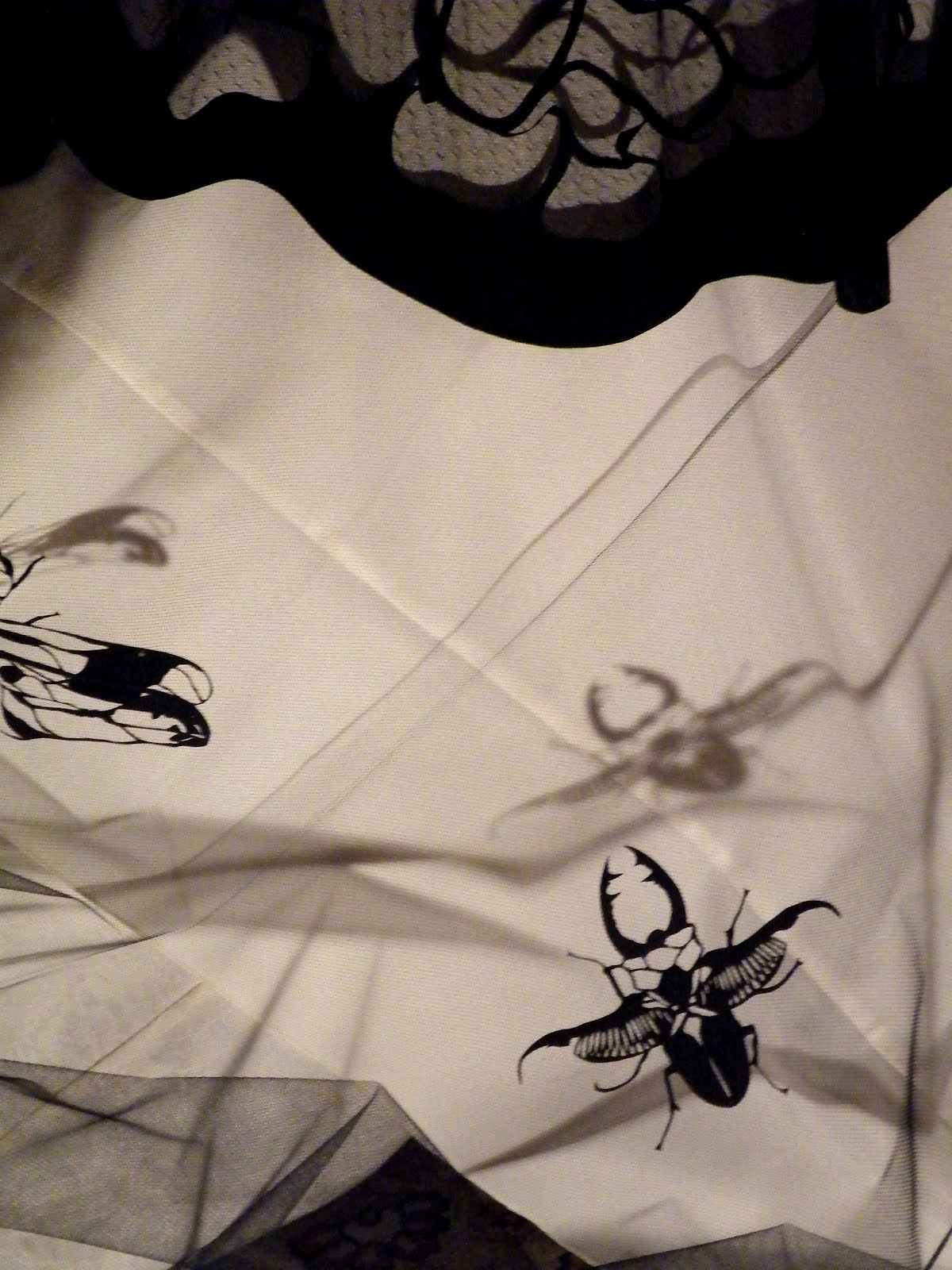
Next on my tour was the Dining Room, wherein lies ensconced the Morses' green dining service amidst other treasures. This room, designed to produce an atmosphere for serious and appreciative dining, has taken on an additional veil of somberness as David Twiss (also responsible for the woodcut invitation design seen around town, and the Cthulhu woodcut banners at the entrance, visible in the first photo above) has draped it in an exquisite hand-cut lace piece which evokes a seance-like feel, the centerpiece of the table a golden glowing orb, and shadows everywhere, delicate and filled with stories to tell.

Moving through the front hall, one's eye is immediately attracted to the Reception Room, which hosts Greta Banks' apocalyptic gold-encrusted vision in pink and orange, "Clearance: The Four Horsemen." The Victorians have nothing on the twentieth century for glorious overkill, it turns out! Also on the first floor we find a carefully assembled series of intricate insects and crustaceans, cobbled delicately from clockwork parts and mounted in bell jars for our worthy inspection, and a tribute to that lowly but much-needed Victorian laborer, the chimneysweep, all by Mike Libby.

On removing to the upper chambers, we enter further realms of shifting shadow and light, discovering Scott Peterman's portraits, the frames of which have been lifted from the Victorian wall decorations and given new technological life as lenticular manifestations -- a true descendant of the Victorian-era stereopticon! But the wonders do not end there. Stephen Burt's treatment of the Red Bedroom introduces the viewer to the shadows and shifting light of the Louisiana bayou, Morse's home away from home. Like the lenticular portraits in the hall, the antique mirror that Morse looked into himself shows multiple reflections of the silhouetted shapes in the window, creating a dreamlike reverie of layers and the partially-seen.

Dazed with fascination, we can proceed to the final entries in this door-to-door steampunk diary which mixes fancy history with historical fancies. The Sitting Room showcases Tom Couture's delectably-lit vignettes of Victorian-garbed subjects amidst the very rooms of the Mansion itself in an improbable yet oh-so-real story the events of which we can only imagine. In the Turkish Smoking Room a single piece stands in state, Brendan Ferri's "Geo-Magnetosphere," a perpetual motion machine frozen in time, whose circuits would be given velocity by the elements of the earth and sun itself.

And to finally blow our minds, Greta Bank has prepared two more brain-breaking masterpieces, "Rat King" and "Cashmere Roadkill," found in the Green Bedroom and the Dressing Room, respectively. Greta's work continues to astound me, year after year. She is Portland's Matthew Barney, with promise of more amazing things to come.

One of my favorite things about this show is that it continues the conceit of the house itself, graced as it is with skillfully executed faux finishes and trompe l'oeil frescoes, designed by Gustave Herter and made real by the brush of Giuseppe Guidicini. Nothing is quite what it seems, even when this exhibit is not here -- and Victoria's Wonderama plays even further with that element. What is, what is not? The heart and soul of wonder is laid bare for us to marvel at here.

Please do take the opportunity to see this show if you can! The likes of it may never be seen again, though we can only trust that the good folks of the Victoria Mansion will be inclined to grace us with new and wondrous exhibits like this in the future. For more info: http://www.victoriamansion.org/