Sunday, January 05, 2020

Maine Bicentennial Community Cookbook!

Hi folks, and HAPPY NEW YEAR!

Many of you like myself can appreciate the part that food plays in the cultural history of Maine.

There are 5 days left to participate in the Kickstarter to help Rabelais Books put together their inspiring project --
The
Maine Bicentennial Community Cookbook! 

[Apologies for the lateness of this alert, 2019 was not kind and I missed a lot of fun things that were brewing.]
If you aren't able to contribute, but have a Maine family food memory, recipe, or image you'd like to send to them as part of the project, do not hesitate! Deadline for submissions is JAN 10!

Submit here: https://www.maine200cookbook.com/home/#submit

Kickstarter here:
https://www.kickstarter.com/projects/maine200cookbook/maine-bicentennial-community-cookbook

Don Lindgren of Rabelais Books has long been a tireless archivist of historical cookery, and I can only imagine as he turns his enthusiasm and focus to the topic of Maine's own recipes that some marvelous and fun treasures are going to be turned up in the hunt. 

Let's do what we can to help him out!  If you have a delicious or notorious family classic that has long been a part of your family gatherings and history, why not send it in and add it to the mix?  It's one small (but tasty) way you can participate in Maine's bicentennial!

If you're curious about Rabelais Books, I encourage you to visit their website, as it (and their catalogs) are a trove of information and imagery on the topic of food books of all sorts:  https://www.rabelaisbooks.com/

Saturday, June 29, 2019

Bigfoot in Maine update, summer musings!

Hi everyone! The warm weather is finally here (mostly), and even the sporadic rainy days are good days to get out into a part of Maine you haven't seen yet.

I'm plugging away on the book, and excited to report that I'm working on the last major chapter (Durham Gorilla!), then all I have to do is add a few bits and pieces in to catch up with some last minute interviews and site visits elsewhere... and then the illustrations!

It's pretty exciting to finally be closing in on what is at this point a decade-long project. It's also exciting that it has been well worth it. I've met a lot of amazing people, and gotten to poke around in corners of Maine I might never have seen otherwise.

It has also become obvious that finally packing the manuscript off to the publisher when I've finished and done a final edit is NOT going to be the end of the work. This project has started what looks to be a lifetime's worth of recording Maine's Bigfoot-related oral history and scattered accounts. I have a feeling that I'll continue exploring this Strange Maine topic for many years to come, even after the book is done.
Skowhegan region driveabout on a rainy day!
Most recently I've been up in the Skowhegan region, where a series of late-1970s sightings occurred. It was a rainy day, but we covered a lot of ground, albeit in a truck because it was pouring rain and there were many meandering miles to traverse, many of them on dirt roads. Many thanks to those of you out there (you know who you are) that helped make this happen.

One of the most important things I've learned throughout this whole process is to be patient, and to be careful. If what I'm hearing from people is as real as it seems to be, we have neighbors that need our respect and possibly someday our protection. It's an intriguing thought to chew on.

I've also learned how important it is to be able to talk openly about the unexplained, because many people encounter it in their lives, always unexpectedly, and if we can't listen to others respectfully about their experiences, we can be sure that if we ever find ourselves in the same situation, ridicule will await us as well.

So please stop and think before you disparage or slap someone down just because they're trying to sincerely share something with you that they can't explain, but need to talk about. Small steps towards making this a better world for all of us. It doesn't take much, guys!

Friday, May 17, 2019

The Poetry of Empty Tombs

Longfellow crypt - Photo by Michelle Y. Souliere, (c)2016
Hi folks! Hope your spring is going well. Here's a little treat from Troy Bennett over at the Bangor Daily News, a piece about one of Portland's long-running mysteries to entertain you while we continue to thaw out.

If you click on the link below, it will take you to the site where you can watch Bennett's 20 minute documentary about his search for the truth about the Longfellow family's tomb.

Longfellow’s tomb is totally empty. We went looking for the bodies.
By Troy R. Bennett, BDN Staff • October 31, 2018 5:56 am
October 31, 2018

[...]

In 1986, the city of Portland went to brick up the Longfellow family tomb in its historic Western Cemetery to protect it from vandals. But when they did so, they discovered the tomb completely empty — no sign of the six family members, including Henry’s parents, who were interred there in the late 19th century.

As a local historian looked into the case more at the time, the mystery deepened.

In his new investigation into the curious case, Bennett retraced the steps of historian Bill Jordan and discovered some new leads.

[...]
[Source:
https://bangordailynews.com/2018/10/31/news/portland/the-curious-case-of-the-poets-empty-tomb/]

If you'd like to see more of Troy Bennett's features on the Bangor Daily News website, you can find them here:
https://bangordailynews.com/author/tbennett/
You can also follow him on Vimeo:
https://vimeo.com/user11806700/videos

Tuesday, March 19, 2019

Maine Wildlife in the Snow - Part 2

I'd better post this before all the snow is gone here in southern Maine (oh, I know there will be some more, but tomorrow is the first day of spring, and I'm perennially optimistic). Back in February I had a chance to go out tromping with a friend, and it being the day after a snowstorm, we found a smorgasbord of animal tracks.
Even in winter some streams keep flowing.
In the post before this one, we looked at coyote and skunk prints. You can read about it here: Maine Wildlife in the Snow - Part 1

This time we'll look at some other tracks and traces left in the snow from that same trip.

The first set wound up being a bit of a joke on us. At first we came across what at a distance looked like the flurry a grouse might leave in the snow.
But on closer inspection, it was pretty clear that it was the sign of a very busy rabbit or hare (not sure whether it was cottontail or snowshoe, but more likely cottontail). Note the telltale droppings, like little punctuation marks!
Next we saw plenty of little mice tracks, with tail marks evident, this one heading toward the safety of a tree:
Last but not least, we found evidence of porcupine nibbling on some of the soft young pines in the area:
Pretty soon all that will be left are pockets of snow in the shadowy areas, and some ice here and there. Come May the leaves will be budding, and eventually leafing out. Not long now! Happy spring, everyone.

Tuesday, March 12, 2019

Maine Wildlife in the Snow

It might not be "strange," but it is rather magical to be able to see the tracks of animals in the Maine winter snow. Back in February I had a chance to go out tromping with a friend, and it being the day after a snowstorm made for a bumper crop of tracks.

A network of tiny critters making their way from seed to seed.

Here are just a few:
Above is a coyote track (there were a lot of these), in which you can see the telltale two-claw dots at the front of the foot (look at the red arrow directing you to the 6:00 point of the photo).

To the right, you can see the full trackway, where the coyote carefully pads along the raised, packed runner left by snowmobilers in the fresh snow, very daintily stepping within the same spots as it moves along. You can see our bootprints along the edge of the coyote's runway to get an idea of scale.

The last track set for this post (I'll come back with more later) was a real puzzler at first. You can see them below. The lateral footpads set behind long toeprints, with prominent claws showing on many of the tracks, indicated a number of species possibilities, but the size, only a few inches long, could only match one thing, if I am not mistaken -- a skunk! So I'm glad we only saw his tracks and not himself.
1. Trackway          2.  Lateral footpad visible          3.  Clawmarks visible

Friday, February 22, 2019

Ermines everywhere!

It sounds like this winter has had a bumper crop of little ermines (short tailed and long tailed weasels in their lovely white winter coats) running amuck in Maine's woods and neighborhoods. Our first post about this phenomenon was back in 2006, and there has been a running commentary on the subject ever since. You can read that earlier post here: Mystery White Critter

We have heard reports from a bunch of places over the years: Poland, Troy, Brewer, Crawford, Casco, Harmony, York, and Naples for starters.

Today I have a treat for you -- one of the folks, Dave Taylor, who had an ermine as an unexpected houseguest earlier this year, had this to say: "We just recently caught a pure white weasel in our home with a live trap. Released him back into the woods on about 50 acres. Have several good photos and videos. Cute little guy." He was kind enough to send along some photos. I never realized exactly how petite they are!

Here is a glimpse of the little fellow in Dave's kitchen, so you can get an idea of his size:
And here he is, safely stowed in his trap, ready to be released back into the wild, just as devilishly cute as ever!
If you want to learn a little more about ermines, here are a couple of good resources -- an article on the Harpswell Heritage Land Trust site: https://hhltmaine.org/nature-notes/nature-notes-weasels/
and another on the Natural Resources Council of Maine site: https://www.nrcm.org/nrcm-creature-feature/ermine/

Saturday, November 03, 2018

Waiting in the woods: in between the words

Adventures outside, between the light & the shadows: trees and so much more to see.
Photo by M. Souliere (c)2018
[The photo above is from a recent fieldtrip with a Maine Guide friend into wild pockets in Androscoggin County.  Click on the photo to see a larger version.]

This post is not so much about the reporting I do, and more about the philosophy and feeling behind it. I don't often say much about this, beyond talking to friends and family about it -- but it seems important that some of these thoughts should find their way here onto my blog.

I've been working on my second book for so long that it astonishes even me sometimes. Fitting it in around a grueling work schedule has been challenging, but this past year or so I feel like I've come much closer to figuring out a solution to fitting those pieces together. There are some more abstract elements that have become clearly very important as part of writing this book.

While my goal is to have Bigfoot in Maine done by the end of this year, the funny thing about it is that it will probably remain a lifelong pursuit even when the book is done.

"Why?!" -- You may well ask.

Why?  First, the truest reasons -- Because it draws me outside, into Maine's woods and hills and waterways.  I crave more outdoors.  In my everyday work life, the outdoors is so close, yet so far away.  I cannot live without it.  I live much better with more of it.  We all need to not only look out, but also to go outside more often.  There is nothing more real than walking into the wind and sun with the growing ground underneath your feet.

Why? Secondly, the draw of curiosity on a growing mind -- Because there are more encounters out there that have never been told outside the small circle of family and friends. I can feel the truth of that in my very bones.

Why? Thirdly, the bigger picture -- Because each link that appears in the chain of Maine oral history strengthens everyone who is part of it.

Why? Fourth, the driving force behind it all -- Because I see myself as having a job -- a vocation. I am here to record these experiences that people have had, even if there is no acceptable "explanation" for them. Perhaps an explanation is not needed.

Why? Fifth, the hoped-for outcome -- Because the record of any experiences given to me in the course of my work stands for those who come after, for those who have not told their own history yet, for those who might think that "no one wants to hear this," that "they're just going to think I'm crazy or an idiot."

I've heard a lot of reasons from people as to why they don't want to come forward.

It's okay to keep things to yourself.   But if you have an encounter that defies all your prior life experience, something that doesn't fit into your known universe, I want to tell you that there are those of us who will listen.

AND --- almost more importantly --- If we are honorable, ethical journalists (or even friends), we will listen off the record -- we won't tell anyone else anything you don't want known. The information is still useful. I am constantly piecing together the massive puzzle that is Maine in all its complexity, and you would be surprised to hear some of the tiny clues that have led to huge breakthroughs and realizations further on down the road.

We will listen, whether you want the details repeated to help others who may be in the same boat, or whether you require us to never tell another soul. We will not assign you derogatory labels just because of something we haven't experienced ourselves happening to you. And those of us who are looking at the bigger picture will be grateful, and remember what you shared when you didn't have to.

You might not hear from us again for years -- or ever -- but know that your piece of the puzzle is percolating through a repository of history where we are all Mainers together, each with our own unique experience of the state and all that is in it.  Without each other, we are made less. Don't think your shot in the dark has been ignored, because these things take time.

In those moments where your piece of the puzzle comes to light and fills in a blank, connecting other pieces together, it helps create an amazing picture of Maine history, rich enough for all of us to give forward as a treasure to those who come after us, asking questions in their own time that only we can answer now.

All this work is done with no promise of glory, no promise of any tangible results.  Those of us who listen, who dig deep when everyone else is doing something they think is more fun -- we are looking long.  We are looking ahead as well as looking behind.

We are also trying to get as close as we can to a 360-degree view, because we know things only become clear when they are given perspective.  We never know what to expect, and that's a good thing.  We make no predictions - we lay our cards out and hope to be given a chance to pay attention enough to see things unfold.

And for those who shy away from telling because of ways they have seen others' stories being exploited by those who take them and don't care about anything but profit and personal gain -- I am sorry that this behavior exists in this world. It is unnecessary and violates everything I stand for. I respect your decision to back away from opening up because you have seen others injured in doing so.

To those who have trusted me with their experiences, thank you.  I came to you a stranger, and you were willing to take a chance that I could help other people with what I could glean from your accounts.  This means a tremendous amount to me, and I try to never let out of my mind for long the reality of how lucky I am that you all looked at me, or heard my voice, or saw my greeting on the screen, and said, "Okay.  I will give you a try."

Thank you all -- those who contribute tales, and those who are eager to see the work when it is done -- all of you.  And thank you for reading what is probably my longest update ever.

The seasons turn, and the daylight shifts.  When I'm not in my bookshop or at home, you'll find me in the woods and out in the air, looking around at the huge world that is encompassed within Maine. Life is short, and I know I'll likely not see all the Maine places I hope to breathe in, but you can be darn sure I'm going to experience as many as I can, whenever I can.

I hope you all get this chance too!

With all my heart,
Your scribe and stumbling fool,
Michelle
Me visiting with my old friend & neighbor, the Crookston Bigfoot, at the International Cryptozoology Museum.


Wednesday, October 24, 2018

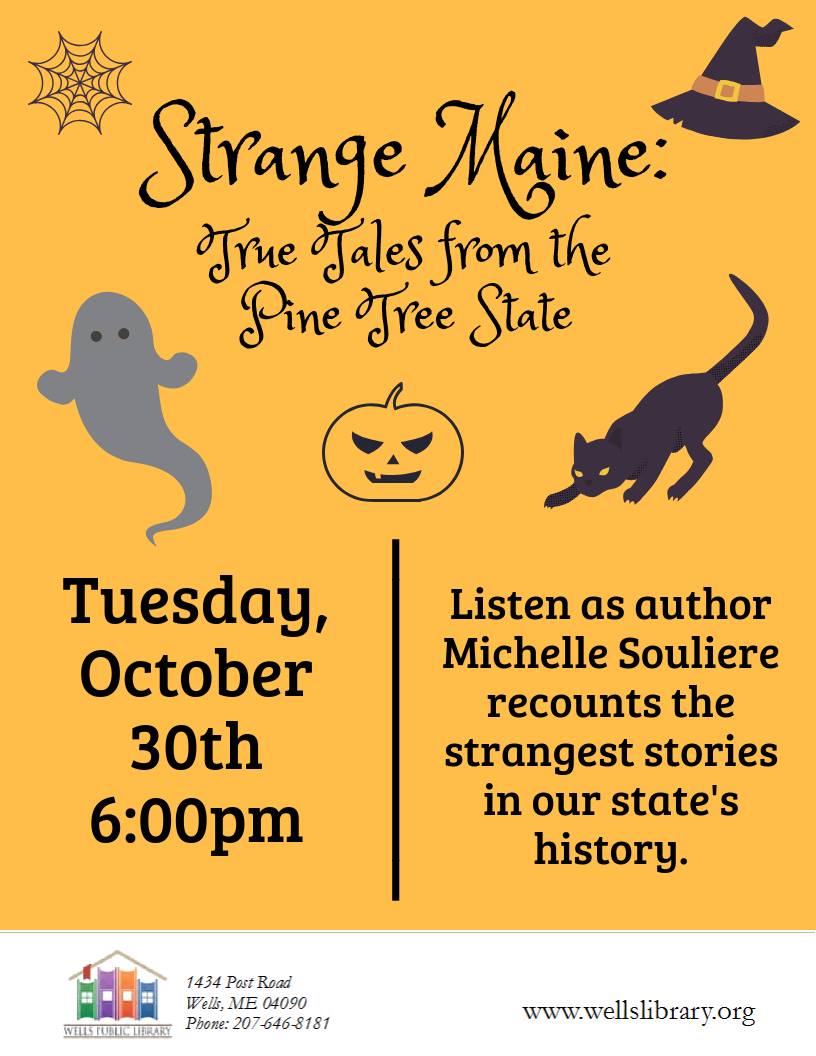
EVENT: Strange Maine at Wells Library for Halloween Eve!

Whoohooooo! I'm giving a spooky-season talk down at Wells Library soon! Come on by if you're in the neighborhood. 👻💕 Cross your fingers there's no hurricane this time!!! ;)

For more information visit the Facebook event page:
https://www.facebook.com/events/404884133377856/
or call Wells Library at (207) 646-8181.

Tuesday, October 16, 2018

REPORT: International Cryptozoology Conference 2018, Day 2

Hi everyone! This post will run down the second day of the weekend's worth of speakers, and my photos will give you a glimpse of the folks involved, if you weren't able to be there. Click on any of the photos below to see a larger version of it.

If you missed the post about the first day's speakers, you can find that here:
http://strangemaine.blogspot.com/2018/09/report-international-cryptozoology.html

The 3rd Annual International Cryptozoology Conference was held on Sept. 1 & 2, 2018, here in Portland, Maine. Like the others before it, it was a great experience -- a chance to hear from experts on a variety of topics, and an opportunity to meet other people as interested in and as excited by the field of cryptozoology as I am.

Loren Coleman, founder of the International Cryptozoology Museum, and his crew put together a terrific lineup of speakers. I wanted to hear every presentation, which works out great since the conference runs as a single-track schedule, allowing attendees to go to all of the talks without missing any of them.

Day 2 started with a very welcome announcement from Loren Coleman that there would be another conference in 2019.
[NOTE: There is a GoFundMe in progress to raise funds to assist with that now, with access to VIP tickets etc, at https://www.gofundme.com/cryptozoology-conference-2019]

This exciting news was followed by Colin Schneider, giving his talk "Bloodsucking Beasties & Shadowy Stalkers: A Study in Cryptid Predators."
Colin is one of the youngest cryptozoologist working in the field today. He is the representative for the Centre for Fortean Zoology in his home state of Ohio. You can find his blog here: http://paranorm101.blogspot.com/

Colin walked us through a smorgasbord of intriguing historic accounts of cryptozoological predators. Culprits included the inevitable Chupacabra, and lesser known ones such as the Vampire Beast of Bladenboro NC, the Abominable Chicken Man of El Reno OK, The Monument City Monster of Indiana, the Phantom Gobbler of Canton Township MI, and a number of other cases as well.

Various theories for each were explored, and Colin alerted the audience of hoaxy oddballs such as photos of bloody handprints and appropriated photos from unrelated incidents, just a few of the problems facing researchers using online sources to find information about these bygone cases and others. Always fact-check your sources, in other words!

Most often, these cryptid predators exhibit patterns related to either feline or canine predators. During the audience Q&A session following, fellow speaker Dawn Prince-Hughes asked if it was known whether habitat loss would trigger surplus killing (a common side-effect of these mystery creatures). A good question to puzzle over.

Next on the docket was Andy McGrath, traveling far to give us his take on the Beasts of Britain!
Although the UK is a closed system, so to speak, as it is predominantly a large island, that does not seem to restrict its variety of cryptozoological cases. For most of the talk, Andy focused on the water monster sightings, including multiple recent (August 2018) Loch Ness photos that have had UK cryptozoology fans very excited, earning 2018 the nickname "Year of the Dragon."

One thing was clear -- for those who think all the UK lake monster photos are from the 60s and 70s (or earlier), they are missing out on all the current ones! For examples you can look up Bownessie, the Dragon of the North, the River Aeron Monster, and the Plymouth Crocodile, among others.

From lake monsters Andy moved on to hairy ape men, again exhibiting a wide array of timeframes for historic traces and new evidence, from designs in heraldry and the Wodewose roof boss in Selby Abbey, N. Yorkshire, all the way up to the Box Hill Ape (2012) and Sussex Ape Man (2015). It should come as no surprise that UK Bigfoot cases are very controversial, and Andy pointed out that what some Bigfoot hunters may take as treesigns in the countryside could well be signals left by the existing gypsy communities traveling through out-of-the-way areas.

Another point of discussion was the spate of Dogmen sightings, which Andy postulated may just be a way of re-branding the werewolf tradition to make it seem less embarrassing, more modern and believable. All in all, a lot was packed in to his talk! You can find him online at http://beastsofbritain.blogspot.com/ or on Facebook.

Next up was Aleksandar Petakov, who gave a terrific account of his latest work, filming the documentary Champ, about the legendary monster of Lake Champlain, as presented by Small Town Monsters. Katy Elizabeth, founder of Champ Search, stepped in and added her own viewpoint about investigating this particular lake monster.

He spoke about the principles that motivate his filmwork, and how important it is to go to the site of the events being documented, and the vitalness of allowing eyewitnesses to speak for themselves. He is a firm believer that you should not try to influence their telling of their account; it should not be scripted. You will find his website at petakovmedia.com, and Small Town Monsters at https://www.smalltownmonsters.com/

Next was my talk about Bigfoot in Maine. I almost skipped myself here, because I didn't have any notes about the talk, being in the process of giving it at the time. Ha!

This talk was the first time I had attempted to summarize everything I've learned from talking to eyewitnesses about their encounters with inexplicable hairy hominids in the state of Maine, from York County all the way up to Aroostook County. I talked about the environment and biology of large mammals in Maine -- what makes anyone think they might be here, and how they could survive. In short, the potential is clear for anyone who has studied Maine's known large mammal species, such as the black bear.

I followed this with examples of incidents from my files, to give the audience a feel for what these Mainers have encountered in the wild and in their back yards. Lastly, I summed up what we know from these accounts -- appearance, eating habits, where encounters have occurred, behavior, etc. All of this will be in my book, which I'm finishing up in 2018. I hope to have it in the publisher's hands by the beginning of 2019. Stay tuned! If you want to stay up to date with my Strange Maine work, you can also follow my site on Facebook: https://www.facebook.com/strangemainebook

Last but certainly not least, the final speaker of the conference was Dr. Jeff Meldrum, a name well-known to anyone with a serious interest in the field of primate cryptozoology. Dr. Meldrum spoke about the Patterson-Gimlin footage, and why he believes it remains the most compelling photographic evidence to date, attesting to the physicality of a biological entity, and providing a baseline from which to establish a scientific context.
He spoke about the shifts that have occurred in views of evolution and anthropology, and how the old paradigm of the field caused preconceptions, which in turn conditioned the collection of evidence for decades. Newer paradigms are slowly coming into place, causing the reexamination of available information. The taxonomy in the field is rapidly changing and readjusting to discoveries initiated by these reevaluations.
Dr. Meldrum also demonstrated his theories of possible hominid foot anatomy, as footprint casts and footprint fossils are among the few forms of evidence being brought forward for examination. Another anatomical aspect he discussed was the deep jaws and flat face (also visible in the Patterson-Gimlin footage), which he postulated to hold massive molars, smaller incisors and cuspids. As he explained, their teeth are their primary tools/utensils. Such a large jaw, with its accompanying massive musculature and the cheekbones housing it, would necessarily obscure the visibility of neck vertebrae, creating the famous "no neck" look ascribed to mystery hominids.

All in all it was a fascinating talk, which gave the audience much to think upon.

The weekend was terrific! I met a lot of interesting folks, both fellow speakers and conference attendees, and also caught up with many friends I hadn't seen in ages.
After all was said and done, I still had time to go over and check out the latest additions of the International Cryptozoology Museum, just across from the conference location. I also got to catch up with my old friend and neighbor, the Crookston Bigfoot.
I hope this has given those of you unable to attend the conference a glimpse at what went on. Maybe we'll see you there next year!

Saturday, October 13, 2018

EVENT: Strange Maine at Wells Library for Halloween Eve!

Whoohooooo! I'm giving a spooky-season talk down at Wells Library soon! Come on by if you're in the neighborhood. 👻💕 Cross your fingers there's no hurricane this time!!! ;)

For more information visit the Facebook event page:
https://www.facebook.com/events/404884133377856/
or call Wells Library at (207) 646-8181.

Monday, September 24, 2018

REPORT: International Cryptozoology Conference 2018, Day 1

Hi everyone! The 3rd Annual International Cryptozoology Conference was held on Sept. 1 & 2, 2018, here in Portland, Maine. Like the others before it, it was a great experience -- a chance to hear from experts on a variety of topics, and an opportunity to meet other people as interested in and as excited by the field of cryptozoology as I am.

Loren Coleman, founder of the International Cryptozoology Museum, and his crew put together a terrific lineup of speakers. I wanted to hear every presentation, which works out great since the conference runs as a single-track schedule, allowing attendees to go to all of the talks without missing any of them.

This post will run down the first day of the weekend's worth of speakers, and my photos will give you a glimpse of the folks involved, if you weren't able to be there.  Click on any of the photos below to see a larger version of it.

Loren kicked off the conference by announcing this year's Cryptozoologist of the Year, reminding everyone that cryptozoology is an active field pursuit for scientists around the globe.

Cryptozoologist of the Year, Dr. Anna Nekaris - BBC photo
This year's honored cryptozoologist is Dr. Anna Nekaris. A professor in Anthropology and Primate Conservation studying the unique group of evolutionarily distinct primates known as the Asian lorises, her work encompasses all eleven loris species, including six she named or elevated from subspecies. Anna is the Course Tutor for the highly acclaimed MSc Primate Conservation at the Oxford Brookes University, Director of the Little Fireface Project and Convenor of the Nocturnal Primate Research Group. The Little Fireface Project (http://www.nocturama.org/en/welcome-little-fireface-project/) performs outreach and education to raise public awareness of the plight of lorises.

A short film about her work, "The Jungle Gremlins of Java," aired on the BBC recently:
https://www.bbc.co.uk/programmes/b01bcp7z

Maybe in some future year, the CzCon can get permission to screen this film at the conference!

First on the speakers schedule was the team-up of Vermonsters Joe Citro and Stephen Bissette, author and artist respectively of The Vermont Monster Guide and many other works.
Author Joseph Citro
Joe Citro started us off, discussing among other things his own sighting of a big cat in Vermont in the 1990s. He described the process eyewitnesses go through when they encounter a strange animal: how each of us has a mental index of animals known to us, and in the moments following the encounter, how we "flip through" all the index cards in search of a correlating species, sometimes coming up empty-handed.

He also discussed his decades of work researching local legends and rumors, and how some of them do turn out to be wild goose chases, while others turn out to be even stranger than expected. In short order we were brought up to date on all sorts of anomalous sightings, including human-faced bats, man-swallowing stones, giant buried bullfrogs, Old Slipperyskin, and the giant birds of Butternut Hill.

Anyone interested in a good read should check out Citro's books, especially my favorite, Passing Strange: True Tales of New England Hauntings and Horrors.

Artist Stephen Bissette - Art on the right is his, for Champ DVD
Steve Bissette tag-teamed, following Citro with his own take on Vermont's monsters of legend. He emphasized the relevance of input from people who are great observers as amateur naturalists, and discussed his own process as an artist illustrating cryptids. He reminded the audience of the important concept that no cryptid exists in a void -- they fit into an ecosystem; they have neighbors; they move through and take part in the local environment.

Fans of Bissette will be pleased to note that he is working on the second volume of his Cryptid Cinema book series, which will focus on The Legend of Boggy Creek (if I heard correctly)!

Next on the roster was a preview of clips from the upcoming film The Cryptozoologist (2019), and a screening of Swan Song of the Skunk Ape (2015).

Following this was Hayley Eldridge's presentation "La Bête du Gévaudan."
image from Bibliothèque nationale de France, via Wikimedia Commons
This case remains sensational even centuries after its record (1764-1767), and still excites speculation and research. Hayley gave a detailed and engaging survey of what we know about the historic record and what might be guessed about the beast from these traces, including her favorite theory, that the creature was a hybrid wolf and Dogue de Bordeaux, a theory that allows for multiple beasts from any given litter, a possible source of the many attacks in different locations.

The talk that followed next featured a person I had never heard of, but she made a profound impact on me, even in such a small amount of time. Dawn Prince-Hughes is a primatologist, and author of Songs of the Gorilla Nation, among other books. Her discussion of gorilla ways was eye-opening and encouraging. Following in the footsteps of Jane Goodall and Dian Fossey, she focuses more on the natural behavior of gorillas and less on how we want them to behave. When she works with them, she prefers to match her gestures and communication to their own innate methods as a means of creating rapport.

While her breakthrough work focuses on gorilla ethnography, she has also explored other sideroads in her own research, including observations on some very interesting relationships between habitual snow monkey movement patterns and the roots of Muay Thai martial art techniques, and more.
Please consider picking up a copy of her book, Songs of the Gorilla Nation, if you would like to learn more about her work! I'm reading it right now, and it is fascinating.
Todd Disotell was the star speaker brought in to wrap up a great first day of the conference. His presentation was titled "DNA and Cryptozoology, or How I Survived 10 Million Dollar Bigfoot Bounty." While he is best known for his work processing DNA on that show, which aired on Spike-TV in 2014, in the real world, Dr. Disotell has been busy training the new generation of DNA specialists while teaching at NYU (http://as.nyu.edu/faculty/todd-disotell.html).

His graduates are active in the field, and have identified new subspecies of gorillas and chimpanzees, and at least 3 new species of monkeys, including the elusive Lesula (Cercopithecus lomamiensis) in the Democratic Republic of Congo. (more info: https://journals.plos.org/plosone/article?id=10.1371/journal.pone.0044271)

His talk focused on the potential for researchers to utilize the recent advances in DNA technology to accomplish species surveys. Using environmental DNA drawn from topsoil, local bodies of water, etc, labs can now determine what species are in a given area, and how long ago they were there in the case of past or transient populations. This is huge news!

We leave traces of our DNA everywhere we go, and so does every other species on earth. This new methodology, environmental DNA metabarcoding, is transforming how we survey animal and plant communities. With this and other tools, Disotell urges us: "Those of us in the cryptozoology field need to do way better than we have done up to now." Up until now, he states, he has seen zero data to convince him of the existence of legendary cryptids, but he is hopeful that access to new DNA technology will advance efforts, especially as the cost has plummeted now.

In other words -- work hard, learn well, and use new tools -- and always keep in mind that DNA is the keystone of species identification.
Also, it's always fun to be wearing the best pair of sneakers at the conference. 😉

UP NEXT: Day Two of CzCon 2018! Stay tuned...!

Saturday, September 22, 2018

Maine Bigfoot encounters - still interested!

A quick note to say YES, I am still interested in hearing from anyone with Maine Bigfoot sightings.

Latest focus of interest is Livermore to Northport corridor, including a swath north and south of this east-west corridor -- for instance China, Unity, Camden, Turner, Leeds, and everything in between.

Please email me (see link in sidebar to right), or call (207)450-6695 and leave a message with a good time to call you back, if you or someone you know has had encounters with something they can't explain in this region, or anywhere else in the state.

Thursday, June 28, 2018

EVENT: International Cryptozoology Conference 2018!

A note for those of you interested in cryptozoology in general, and Maine Bigfoot -- I will be joining the star-studded line-up of speakers at the International Cryptozoology Museum Conference for its 3rd annual event here in Portland, Maine, at the beginning of September! Last year tickets sold out in advance, so if you really do want to attend, please be aware that it is better to buy your tickets sooner rather than later to avoid disappointment.  😉

I'm really excited to talk about my research on Maine Bigfoot, and to hear the other speakers, including Jeff Meldrum, Todd Disotell, Paul LeBlond, and of course Loren Coleman himself! It's also a great opportunity to visit the International Cryptozoology Museum (practically right next door to the conference), never mind being able to stock up on the latest cryptozoology books and films, plus pick up some fantastic artwork, all available right from the source in the vendors room!

I'm including a few pics below from last year's conference, featuring artist Stephen Bissette speaking on Vermont's Pigman and other creatures, Bruce Champagne's discussions of sea serpent types, Robert Schneck's revealing illumination of the dark corners of the historic Ape Canyon episode, Linda Godfrey's research on dogmen/wolfmen (including the Palmyra, ME, encounters), and one of many amazing creations from Kim Parkhurst at Toadbriar.com found in the vendor room.

FMI: http://www.cryptozoonews.com/icc2018-x/


Tuesday, May 01, 2018

Springtime Bears! A message from Maine Inland Fisheries & Wildlife

Hi everyone! In the process of my Strange Maine research, I have long been interested in the life and history of large Maine mammals, including our resident black bear population. With that interest in mind, and in the interest of helping Mainers avoid creating sources of nuisance bear activity, I'd like to share the following information with you, as issued last week by the Maine Maine Dept. of Inland Fisheries and Wildlife.

These are all proven measures to eliminate human/bear conflict, so please help out yourselves and your bear neighbors by following these guidelines!

* * * * *

Please Remove Potential Meals So Bears Don’t Become A Nuisance!


It's that time of the year again! Spring, mud season, call it what you will, this is also the time when Maine's black bears are emerging from their winter dens.

With natural foods in short supply this time of year, the Department of Inland Fisheries and Wildlife is already receiving calls concerning bears looking for easy meals in backyards around birdfeeders, trash cans, chicken coops and grills.

The department reminds Mainers to remove potential bear attractants from their yard. This is an easy and effective way to avoid problems at your home.

You can learn more at maine.gov/ifw/fish-wildlife/wildlife/wildlife-human-issues/living-with-wildlife/bears.html -- the rangers have assembled a large amount of very useful information, including helpful PDF printouts of the basic steps to take at home.

“Due to the late spring, we anticipate that bear complaints could reach higher than normal levels this year. Spring is the time of year when natural foods for bears are scarcest, and as a result bears will often seek accessible food in people’s back yards,” says Jen Vashon, IFW’s bear biologist.

As of the end of April, the department had already received almost 30 nuisance bear complaints in 2018, with the majority coming from the Kennebunk/Arundel area as well as the greater Bangor area.

Every year, the Department handles approximately 500 nuisance bear complaints, with May, June, and July being the busiest months for these.

“Maine has a growing bear population and bears are becoming more common in central and southern Maine, increasing the potential for conflicts,” said Vashon. “We want to remind people to remove attractants so they don’t create a potentially dangerous interaction with a bear.”

Black bears emerge hungry from their dens after losing between 15-40% of their weight during winter. They immediately start looking for food. Wouldn't you, after such a long nap?

Bears will often turn to suburban attractants such as bird feeders, pet food, and unsecured garbage bins when natural foods are not available.

“It is important for people to be proactive so they don’t attract bears to their homes. Don’t wait until a bear gets to your birdfeeder or grill. They become accustomed to the location where they find food and they will return,” said Vashon.

Much of a bear’s diet is vegetation, and many natural foods such as leaves and grasses are not yet available due to the slow retreat of snow and ice, and the delay in warming temperatures this year. Normally, the spring thaw triggers local plant life to start budding early, creating spring food sources for black bears.

Each spring, bears will feed on grasses and sedges near wetlands, as well as the roots, tubes and bulbs of plants, including skunk cabbage. Bears are also opportunistic carnivores, and will also feed on moose calves, deer fawns, and small livestock.

In recent years, complaints associated with small livestock such as chickens have increased as backyard farming becomes more popular. To protect your livestock, please keep them behind a fence. At night, keep your animals in a secure building.

Bears that live near people often rely on foods inadvertently provided by people, such as highly nutritional sunflower seeds being fed to birds. Birdseed and other attractants should be removed to prevent attracting or creating nuisance bears.

In order to keep your home less attractive to bears, please:

• Take down bird feeders, rake up and dispose of bird seed on the ground, and store remaining bird seed indoors.

• Keep garbage cans inside until the morning of trash pickup

• Keep your barbecue grill clean by burning off any food residue, disposing of wrappers and cleaning the grilling area after use. If possible, store grills inside when not in use.

• Store pet and livestock food inside, and cleanup any uneaten food.

• Keep small livestock behind a fence or in a secure building, especially at night.

• Keep dumpster lids closed and locked.

• Keep outbuilding and garage doors closed.


By taking these precautions, you are more likely to prevent conflicts that could create a dangerous situation, or which might require corrective action such as moving or killing a bear. Removing these food sources will also limit other backyard visitor (raccoons, skunks, etc.).

If you encounter a bear, do not approach the bear -- instead, slowly back away.

If the bear approaches you, try to intimidate the bear by waving your arms and making loud noises, such as clapping your hands or banging pots together. Do not corner a bear -- when cornered, a bear may charge.

Always back away, while giving the bear an escape route. Although bear attacks are extremely rare, if a bear charges you, stand your ground and if necessary fight back.

For more information, visit mefishwildlife.com.